Night · Fourth Prahar · Usha उषा
Raag Lalit राग ललित
Both fourths, no fifth at all. A phrase held in the air, refusing to land before the sun does.
When to listen to Raag Lalit
Raag Lalit belongs to the eighth of the eight prahars, Usha (night · fourth prahar). The last watch before dawn.
On a day with sunrise at six and sunset at six, that is roughly 3 am – 6 am. The prahars are measured from the sun, not the clock, so the window moves through the year and from place to place. The station works out the prahar from your own sunrise and plays what belongs to it.
What to listen for
Lalit uses both forms of the fourth, natural and sharp, placed right beside each other, and leaves out the fifth entirely. By rule this should not hang together. It is sung in the last watch before dawn, into the dark, with no sign yet of light.
Without a fifth, the two fourths do the work a fifth usually does. They hold the phrase in the air without ever letting it land. That refusal to resolve is not a flaw. The sun has not risen. Nothing should feel settled yet.
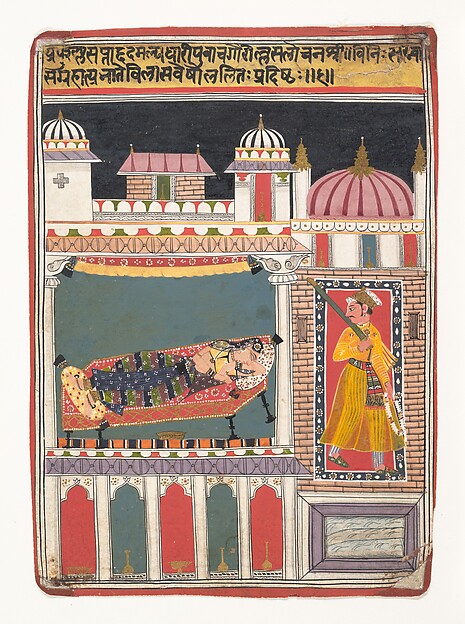
Aroha, avaroha and pakad of Raag Lalit
| Thaat | Marwa/Purvi ang |
|---|---|
| Aroha (ascent) | Ni Re Ga Ma Ma# Dha Ni Sa |
| Avaroha (descent) | Sa Ni Dha Ma# Ma Ga Re Sa |
| Pakad | Ni Re Ga Ma Ma# Ga Re Sa |
| Vadi | Ma (shuddha) |
| Samvadi | Sa |
| Swaras used | 7 of 12: Sa Re Ga Ma Ma# Dha Ni |
| Prahar | Night · Fourth Prahar (Usha) |
Notation: lowercase is komal (flat), Ma# is tivra (sharp), everything else is shuddha.
How Raag Lalit differs from similar raags
Lalit and Kedar
Both keep two forms of Ma. Kedar has Pa and rests on it; Lalit has no Pa at all, which is why Kedar settles and Lalit never does.
Lalit and Marwa
Marwa also drops Pa and takes komal re, but has only tivra Ma. The second Ma is what makes Lalit sound suspended rather than austere.
Lalit and Puriya
Puriya shares Marwa's material and likewise omits Pa. It stays in the middle octave and avoids Dha in ascent, where Lalit gives Dha real weight.
Listen: Raag Lalit
Indrani Mukherjee
Film songs based on Raag Lalit
- Tu Hai Mera Prem Devta — Kalpana (1960), music by O.P. Nayyar, sung by Mohammed Rafi, Manna Dey.
- Ek Shahenshah Ne Banwa Ke Haseen Taj Mahal — Leader (1964), music by Naushad, sung by Mohammed Rafi, Lata Mangeshkar. Attribution varies; Lalit is the most commonly cited reading.
Film songs borrow a raag's scale without always keeping its grammar, so attributions like these are widely published but rarely unanimous.
Origin
Legend credits its creation to Shiva, made to soothe Parvati. Whatever its actual age, it was carried firmly into the concert repertoire by Tansen, who is said to have used it extensively.
Worth knowing
Lalit is unusual enough in structure, two forms of Ma and no Pa, that several distinct raags share the name with materially different scales. "Lalit" in one gharana's repertoire is not guaranteed to match another's note for note.
How sure is the time placement
well attested. The definitive pre-dawn raag, distinguished by using both forms of Ma while omitting Pa entirely.
Sources: N.A. Jairazbhoy, The Rāgs of North Indian Music (1971); V.N. Bhatkhande, Kramik Pustak Malika; ITC Sangeet Research Academy raag notes.