Day · First Prahar · Pratah प्रातः
Raag Bhairav राग भैरव
The first light, still arriving. A flat second and flat sixth pulled hard toward the tonic.
When to listen to Raag Bhairav
Raag Bhairav belongs to the first of the eight prahars, Pratah (day · first prahar). First light. The sun is on the horizon and the air has not warmed.
On a day with sunrise at six and sunset at six, that is roughly 6 am – 9 am. The prahars are measured from the sun, not the clock, so the window moves through the year and from place to place. It is a sandhi prakash raag, sung at the junction where night and day change over. The station works out the prahar from your own sunrise and plays what belongs to it.
What to listen for
Bhairav opens with a flat second and a flat sixth, both pulled hard toward the tonic. That pull is the entire raag. It is what makes the note before sunrise sound like it is still arriving, not yet settled into the day.
Play it after nine and it sounds like grief for no reason. Play it before the light comes and the same phrase sounds like patience. Nothing in the notes changed. Only the hour did.
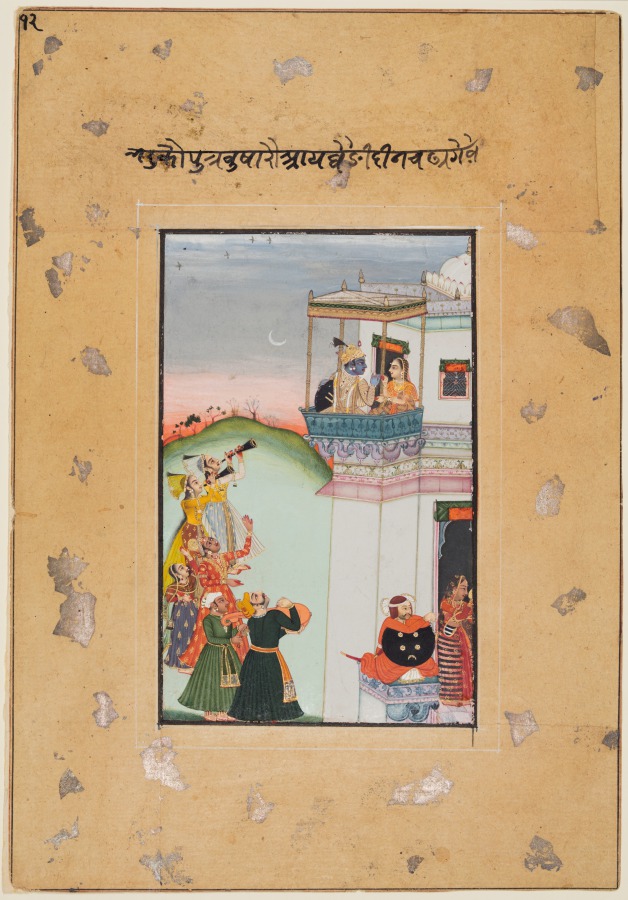
Aroha, avaroha and pakad of Raag Bhairav
| Thaat | Bhairav |
|---|---|
| Aroha (ascent) | Sa re Ga Ma Pa dha Ni Sa |
| Avaroha (descent) | Sa Ni dha Pa Ma Ga re Sa |
| Pakad | Ga Ma dha dha Pa, Ga Ma re Sa |
| Vadi | dha (komal Dha) |
| Samvadi | re (komal Re) |
| Swaras used | 7 of 12: Sa re Ga Ma Pa dha Ni |
| Prahar | Day · First Prahar (Pratah) |
Notation: lowercase is komal (flat), Ma# is tivra (sharp), everything else is shuddha.
How Raag Bhairav differs from similar raags
Bhairav and Ahir Bhairav
Identical below Pa. Above it they part: Bhairav keeps komal Dha and shuddha Ni, Ahir Bhairav takes shuddha Dha and komal ni. Bhairav stays severe, Ahir Bhairav softens.
Bhairav and Kalingada
The same seven swaras. Kalingada moves fast and skips through the scale, where Bhairav dwells and oscillates. The notes cannot tell them apart; only the pace can.
Bhairav and Ramkali
Ramkali is Bhairav with tivra Ma and komal ni admitted as passing touches in descent. Remove those and you are back in Bhairav.
Listen: Raag Bhairav
Raag Bhairav Pandit Ulhas Kashalkar
Film songs based on Raag Bhairav
- Mohe Bhool Gaye Sanwariya — Baiju Bawra (1952), music by Naushad, sung by Lata Mangeshkar.
- Jaago Mohan Pyare — Jagte Raho (1956), music by Salil Chowdhury, sung by Lata Mangeshkar.
- Raat Bhar Ka Hai Mehmaan Andhera — Sone Ki Chidiya (1958), music by O.P. Nayyar, sung by Mohammed Rafi, Asha Bhosle. Bhairav in outline; the treatment is looser than a classical rendition.
Film songs borrow a raag's scale without always keeping its grammar, so attributions like these are widely published but rarely unanimous.
Origin
One of the oldest thaats in the system, named for Bhairava, the fierce, ash-covered form of Shiva. It has no single author. It appears already fully formed in the earliest surviving treatises on raag.
Worth knowing
Bhairav gives its name to an entire thaat (parent scale) of ten raags. Ahir Bhairav and Ramkali both descend from it. It is traditionally the first raag taught to students, on the reasoning that its severity forces good intonation early.
How sure is the time placement
well attested. Cited without dispute as the first raag of the day, across Bhatkhande's system and every gharana.
Sources: N.A. Jairazbhoy, The Rāgs of North Indian Music (1971); V.N. Bhatkhande, Kramik Pustak Malika; ITC Sangeet Research Academy raag notes.