Night · Third Prahar · Madhyaratri मध्यरात्रि
Raag Darbari Kanada राग दरबारी कानड़ा
A flat third and sixth, held and made to waver. The hour when nothing else is happening.
When to listen to Raag Darbari Kanada
Raag Darbari Kanada belongs to the seventh of the eight prahars, Madhyaratri (night · third prahar). The middle of the night. Gravity and stillness.
On a day with sunrise at six and sunset at six, that is roughly midnight – 3 am. The prahars are measured from the sun, not the clock, so the window moves through the year and from place to place. The station works out the prahar from your own sunrise and plays what belongs to it.
What to listen for
Darbari asks you to sit on a flat third and a flat sixth and let them waver. Not vibrato, a real oscillation, wide enough that a student's first attempt usually sounds simply out of tune. It is not. The waver is the raag.
This is Tansen's court music, or close to it, built for the hour when nothing else is happening. Silence around the notes is not empty space to fill. It is load-bearing.
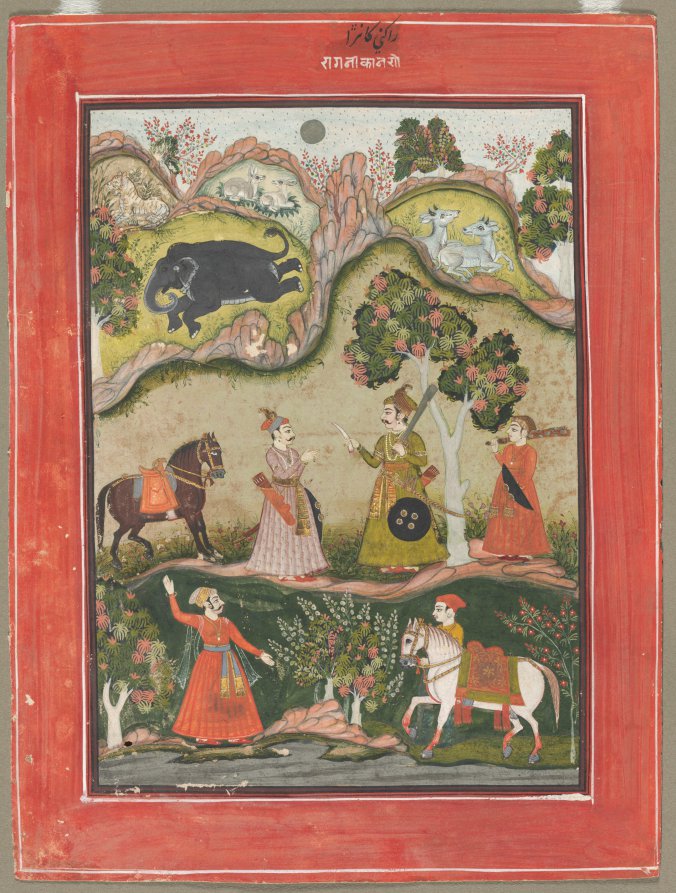
Aroha, avaroha and pakad of Raag Darbari Kanada
| Thaat | Asavari |
|---|---|
| Aroha (ascent) | Sa Re ga Ma Pa dha ni Sa |
| Avaroha (descent) | Sa ni dha Pa Ma ga Re Sa |
| Pakad | ga Ma Re Sa, ni dha Pa |
| Vadi | Re (shuddha) |
| Samvadi | Pa |
| Swaras used | 7 of 12: Sa Re ga Ma Pa dha ni |
| Prahar | Night · Third Prahar (Madhyaratri) |
Notation: lowercase is komal (flat), Ma# is tivra (sharp), everything else is shuddha.
How Raag Darbari Kanada differs from similar raags
Darbari Kanada and Adana
The same swaras. Adana is quick, lives in the upper octave, and touches komal ga lightly in passing; Darbari is slow, lives low, and oscillates that ga until it bends. Tempo and register separate them, not notes.
Darbari Kanada and Jaunpuri
Jaunpuri takes komal ga straight, with no oscillation, and moves plainly. Strip the andolan out of Darbari and you have drifted into Jaunpuri.
Darbari Kanada and Asavari
The parent thaat. Asavari drops Re from its ascent and centres on komal dha. Darbari keeps Re as its vadi, which is why it feels anchored where Asavari feels plaintive.
Listen: Raag Darbari Kanada
Pt.Ulhas Kashalkar
Film songs based on Raag Darbari Kanada
- Jhanak Jhanak Tori Baje Payaliya — Mere Huzoor (1968), music by Shankar-Jaikishan, sung by Manna Dey.
- Tora Man Darpan Kehlaye — Kaajal (1965), music by Ravi, sung by Asha Bhosle.
- O Duniya Ke Rakhwale — Baiju Bawra (1952), music by Naushad, sung by Mohammed Rafi. Opens in Darbari and moves through other raags as it builds.
Film songs borrow a raag's scale without always keeping its grammar, so attributions like these are widely published but rarely unanimous.
Origin
By tradition brought into Hindustani music by Miyan Tansen at the Mughal court of Akbar, who is said to have favoured it above all others. Its name comes straight from darbar, Persian for "court."
Worth knowing
Ustad Abdul Karim Khan and later Ustad Amir Khan are widely credited with the slow, weighty modern treatment of Darbari. The style most listeners now think of as definitive is largely a twentieth-century refinement, not the Mughal original.
How sure is the time placement
well attested. The canonical raag of deep night, closely tied to the court repertoire attributed to Mian Tansen.
Sources: N.A. Jairazbhoy, The Rāgs of North Indian Music (1971); V.N. Bhatkhande, Kramik Pustak Malika; ITC Sangeet Research Academy raag notes.