Night · Second Prahar · Nishith निशीथ
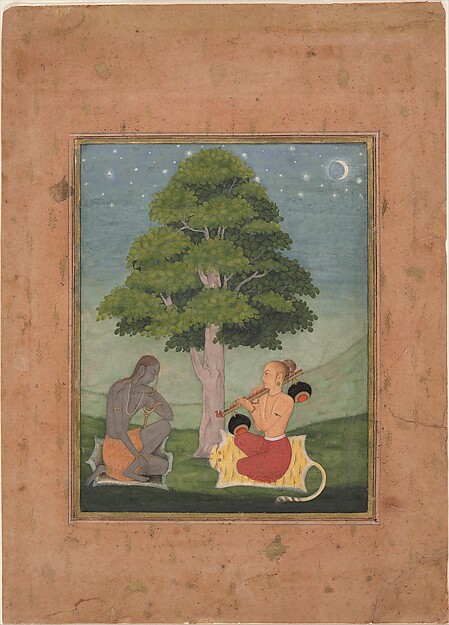
Raag Kedar राग केदार
Both fourths, natural and sharp, kept close. A room gone quiet but not yet asleep.
When to listen to Raag Kedar
Raag Kedar belongs to the sixth of the eight prahars, Nishith (night · second prahar). Deep evening. The concert hour.
On a day with sunrise at six and sunset at six, that is roughly 9 pm – midnight. The prahars are measured from the sun, not the clock, so the window moves through the year and from place to place. The station works out the prahar from your own sunrise and plays what belongs to it.
What to listen for
Kedar keeps both fourths, natural and sharp, sitting close together in the same phrase, which is unusual and should sound wrong. It does not, because the raag never lingers on either one long enough to force a choice.
Some houses treat Kedar as available at any hour past sunset. I have never found that convincing. The phrase wants the stillness of early night specifically, the hour when a room has gone quiet but no one has gone to sleep yet.
Aroha, avaroha and pakad of Raag Kedar
| Thaat | Kalyan |
|---|---|
| Aroha (ascent) | Sa Ma Pa Dha Ni Sa |
| Avaroha (descent) | Sa Ni Dha Pa Ma# Ma Ga Ma Re Sa |
| Pakad | Sa Ma Pa Dha Pa, Ma# Ma Ga Ma Re Sa |
| Vadi | Ma (shuddha) |
| Samvadi | Sa |
| Swaras used | 8 of 12: Sa Re Ga Ma Ma# Pa Dha Ni |
| Prahar | Night · Second Prahar (Nishith) |
Notation: lowercase is komal (flat), Ma# is tivra (sharp), everything else is shuddha.
How Raag Kedar differs from similar raags
Kedar and Yaman
Yaman never touches shuddha Ma; Kedar depends on having both. Kedar also skips Re and Ga climbing, so its ascent is bare where Yaman's is full.
Kedar and Hamir
Both use both forms of Ma and belong to the evening. Hamir leans on Dha and moves in wide zigzags; Kedar leans on shuddha Ma and moves stepwise.
Kedar and Chhayanat
Chhayanat gives Re much more weight and uses tivra Ma sparingly. Kedar's centre is Ma; that is the quickest way to tell them apart by ear.
Listen: Raag Kedar
Deborshee Bhattacharjee
Film songs based on Raag Kedar
- Aapki Nazron Ne Samjha — Anpadh (1962), music by Madan Mohan, sung by Lata Mangeshkar. Commonly attributed to Kedar, though some sources hear it closer to Yaman.
- Humko Man Ki Shakti Dena — Guddi (1971), music by Vasant Desai, sung by Vani Jairam.
- Darshan Do Ghanshyam — Narsi Bhagat (1957), music by Ravi, sung by Hemant Kumar, Manna Dey, Sudha Malhotra. Sources split between Kedar and Bhairavi for this one.
Film songs borrow a raag's scale without always keeping its grammar, so attributions like these are widely published but rarely unanimous.
Origin
Named, most likely, for Kedarnath, a Himalayan form of Shiva. That puts it among the raags named for a temple rather than a place or person.
Worth knowing
Kedar is a favourite closing raag for concerts that run past sunset, in part because its stately, uncomplicated movement makes it forgiving to end on after a long recital of harder, more ornamented raags.
How sure is the time placement
attested, minor variation. Associated with the evening, but some performers treat it as time-flexible rather than hour-bound.
Sources: N.A. Jairazbhoy, The Rāgs of North Indian Music (1971); V.N. Bhatkhande, Kramik Pustak Malika; ITC Sangeet Research Academy raag notes.