Night · First Prahar · Pradosh प्रदोष
Raag Yaman राग यमन
A sharpened fourth, never the natural one. A door opening rather than a threshold.
When to listen to Raag Yaman
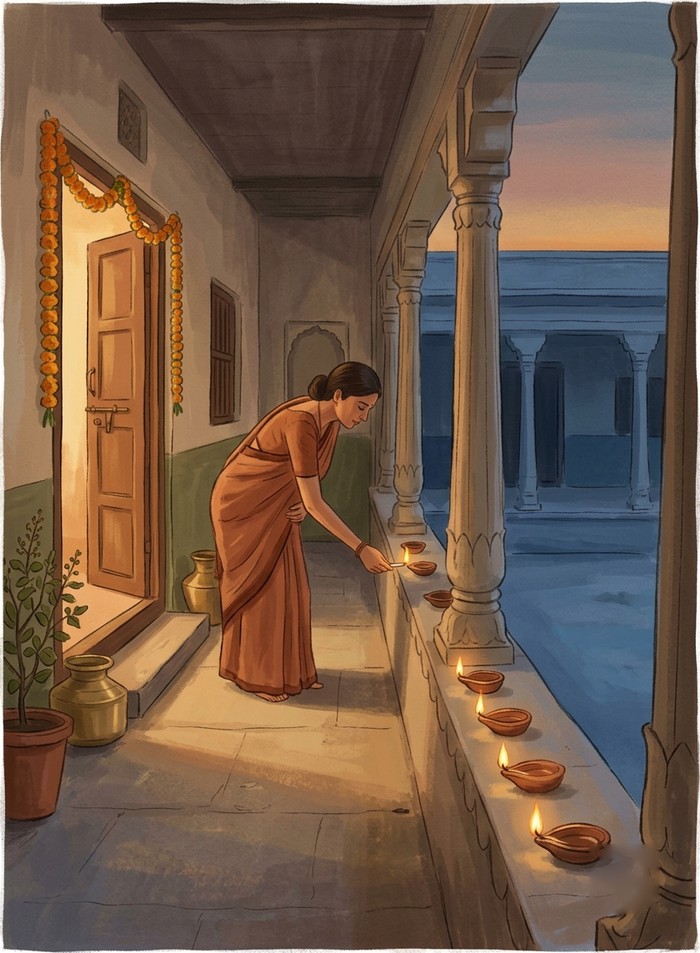
Raag Yaman belongs to the fifth of the eight prahars, Pradosh (night · first prahar). Dusk and early evening. The sandhi, the junction hour.
On a day with sunrise at six and sunset at six, that is roughly 6 pm – 9 pm. The prahars are measured from the sun, not the clock, so the window moves through the year and from place to place. It is a sandhi prakash raag, sung at the junction where night and day change over. The station works out the prahar from your own sunrise and plays what belongs to it.
What to listen for
Yaman is the most performed raag in this entire system, which is a problem for saying something true about it briefly. Start here: it uses a sharpened fourth and never touches the natural one, and that substitution is why it sounds like a door opening rather than a threshold.
Every student learns Yaman first because dusk is when a house exhales. Don't let the familiarity make you careless with the phrase from Ni to Ga. It is the whole raag in four notes.
Aroha, avaroha and pakad of Raag Yaman
| Thaat | Kalyan |
|---|---|
| Aroha (ascent) | Ni Re Ga Ma# Pa Dha Ni Sa |
| Avaroha (descent) | Sa Ni Dha Pa Ma# Ga Re Sa |
| Pakad | Ni Re Ga, Ma# Ga, Re Ni Sa |
| Vadi | Ga |
| Samvadi | Ni |
| Swaras used | 7 of 12: Sa Re Ga Ma# Pa Dha Ni |
| Prahar | Night · First Prahar (Pradosh) |
Notation: lowercase is komal (flat), Ma# is tivra (sharp), everything else is shuddha.
How Raag Yaman differs from similar raags
Yaman and Yaman Kalyan
Yaman Kalyan admits shuddha Ma as a passing touch on the way down. Yaman proper never touches it. One note, and the schools have argued about it for a century.
Yaman and Kedar
Both live in Kalyan thaat with tivra Ma. Kedar uses both forms of Ma and drops Re and Ga from its ascent; Yaman is full in both directions and never takes shuddha Ma.
Yaman and Bhupali
Bhupali is Yaman with Ma and Ni removed entirely, leaving five notes. What sounds like a simpler Yaman is a separate raag with its own hour.
Listen: Raag Yaman
Ayan Sengupta
Film songs based on Raag Yaman
- Jab Deep Jale Aana — Chitchor (1976), music by Ravindra Jain, sung by Yesudas, Hemlata.
- Ehsaan Tera Hoga Mujh Par — Junglee (1961), music by Shankar-Jaikishan, sung by Mohammed Rafi.
- Chandan Sa Badan — Saraswatichandra (1968), music by Kalyanji-Anandji, sung by Mukesh, Lata Mangeshkar.
- Abhi Na Jao Chhod Kar — Hum Dono (1961), music by Jaidev, sung by Mohammed Rafi, Asha Bhosle.
Film songs borrow a raag's scale without always keeping its grammar, so attributions like these are widely published but rarely unanimous.
Origin
Defines the Kalyan thaat. Some historians trace the name to Yemen and credit its introduction to the Persian-inflected court music of the Delhi Sultanate, a claim repeated often and proven by no one.
Worth knowing
Almost every instrumentalist and vocalist learns Yaman before any other evening raag. It is often the very first raag taught after Bhairav, making the two the twin poles, dawn and dusk, of a student's early training.
How sure is the time placement
well attested. The most performed raag at this hour, cited without dispute across every school.
Sources: N.A. Jairazbhoy, The Rāgs of North Indian Music (1971); V.N. Bhatkhande, Kramik Pustak Malika; ITC Sangeet Research Academy raag notes.